


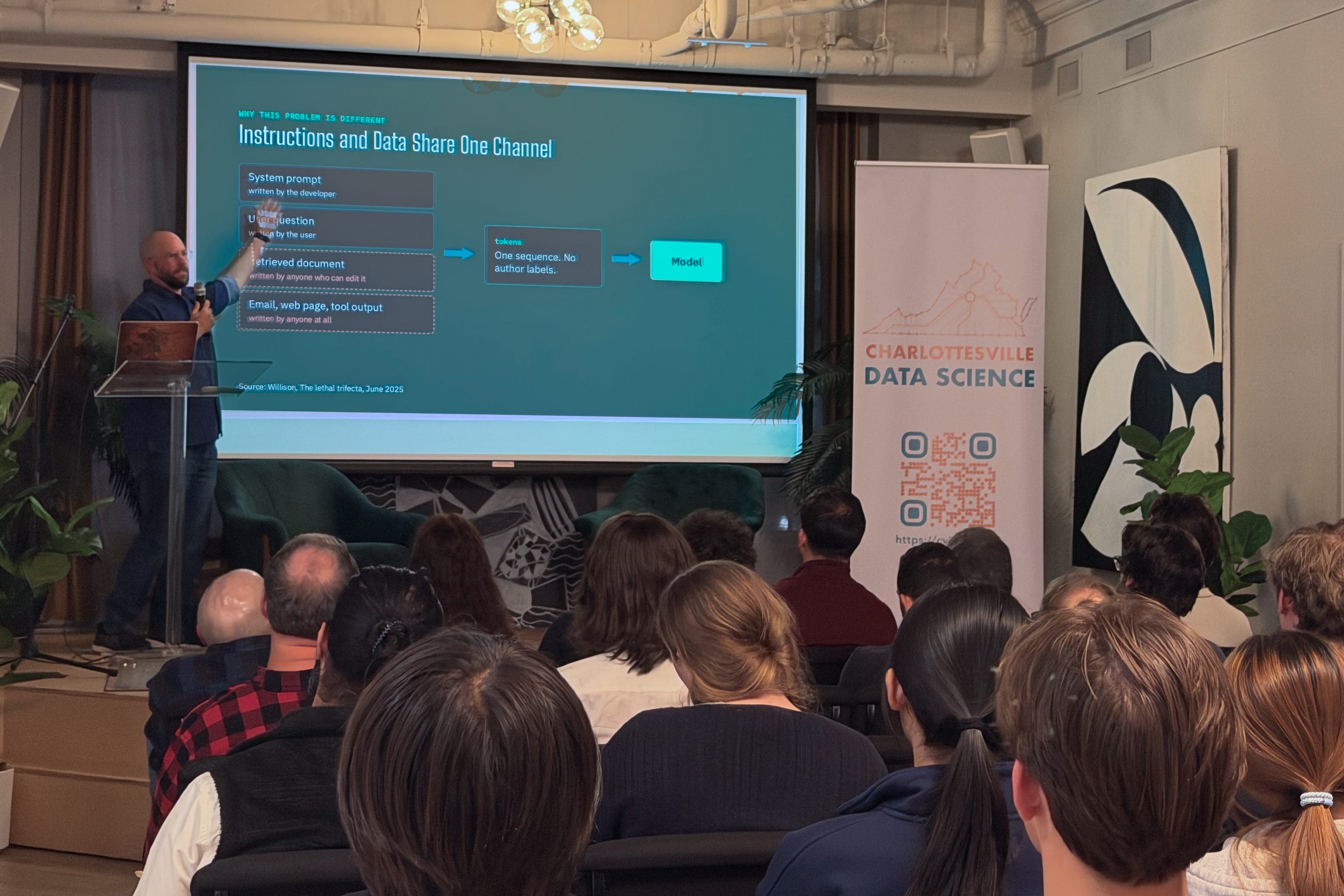
Thanks for joining us on Wednesday for Charlottesville Data Science’s November event, How AI Systems Leak the Data They’re Built On, featuring Hunter Moore, co-founder and CTO of Hardshell, a Charlottesville-based AI security startup. We had a great turnout and a lively discussion about the ways AI systems can be fooled to divulge sensitive information, and what we can do as users and developers to protect ourselves and limit the damage.
If you’d like to review Hunter’s slides, they’re available below. And stay tuned for an announcement about our December event very soon!

Call for Demos: Show Us Your Agent Skills
Are you using AI agents in your data-centric workflows? If so, how? What’s working, and what’s not? Consider giving a quick demo of your agentic AI skills at a future Charlottesville Data Science event!
One of my favorite data science podcasts is Vanishing Gradients by Hugo Bowne-Anderson. This year, Hugo has been running an excellent series called Show Us Your (Agent) Skills, in which long-time Python, ML, AI, and data builders show how they’re actually using AI agents today. I’d love to replicate this idea within the Charlottesville Data Science community.
If you’re using AI agents to assist with data analysis, machine learning development, data engineering, or any other data-centric workflow, and you’re game to give a brief demo for your fellow community members in a friendly environment, we’d love to hear from you. Please submit your idea through the Charlottesville Data Science Call for Proposals!
Cool stuff from the Charlottesville Data Science community
Justin Schroeder, Andrew Boyd, and Luan Nguyen brought their startup, Standard Agents, out of stealth.
Nish Tahir published Running a Language Model on a $35 FPGA, describing how he got a language model with ~1M parameters running on a Field Programmable Gate Array with 144KB of memory.
Mike Pfaffenberger published Code mode: make your agents 2x faster and 2x cheaper on long tasks on the Pydantic blog, exploring the benefits of letting your coding agent write a little program that calls a sequence of tools at once, instead of the model calling them one at a time.
More upcoming events around Charlottesville
Tuesday, November 17: rvatech/ holds its annual rvatech/Women in Technology Conference at the Science Museum of Virginia in Richmond.
Wednesday, November 18: Cville AI Explorers hosts a Show & Share at Studio IX. Up to eight community members get 15 minutes each to demo what they’ve been building, from an “AI software factory” to an offline AI-powered rotary phone. A few speaking slots were still open at last check!
Wednesday–Thursday, November 18–19: UVA's Contemplative Sciences Center hosts AI Anxiety + Human Flourishing, a two-day public symposium on preparing young adults for a future with AI. Speakers include Reddit co-founder Alexis Ohanian, AI ethics researcher David Danks, and UVA President Scott Beardsley.
Tuesday, December 1: The Tom Tom Foundation hosts The Infrastructure of Tomorrow: Data Centers, AI, and Virginia’s Future, a conversation with State Senator Creigh Deeds and Delegate Katrina Callsen about whether Virginia can remain a leader in the digital infrastructure economy — while also protecting affordability, sustainability, and the long-term interests of its communities.
Friday, December 4: The LaCross Institute for Ethical Artificial Intelligence in Business at UVA Darden hosts its fourth annual UVA Conference on Ethical AI in Business at The Forum Hotel, bringing together leaders from business, technology, and policy to talk about adopting AI responsibly. This year’s theme is “The AI Readiness Imperative: Preparing People & Organizations for Responsible AI.”
Wednesday, December 9: Charlottesville Data Science hosts our December event. Joel Fernandes, Principal Engineer at NVIDIA, will present the talk Attention May Be All You Need — But How Does It Actually Work? Joel will first demystify the attention mechanism foundational to modern AI systems, then survey a variety of tricks and techniques researchers are using to speed it up and scale it to ever-larger context sizes.